After finally completing the first course I was ready to start the next one in the Google IT Support Professional certificate; the bits and bytes of networking. I was looking forward to commencing this course as I feel I will really begin to learn some technical knowledge here.
The first module was an introduction to networking and consisted of the following learning objectives:
- To describe how the TCP/IP five layer network model works
- To identify basic networking devices
- To label each of the five layers in the TCP/IP network model
- To describe how the physical layer works
- To describe how the data link layer works

I began my studies by learning the concept of the five layer network model and each of the layers it consists of; the physical layer, data link layer, network layer, transport layer and the application layer. I learnt about some basic devices used in networking and how copper or fibre optic cables are used to connect hubs & switches, utilising duplexing to transfer data and thus forming the physical layer of a network.
Next, I got stuck in to the data link layer of a network, understanding how ethernet protocols and MAC addresses are used to provide software with the means to send or receive data. I learnt that ethernet solves the issue of single collision domain by using CSMA CD to determine when channels are free to transmit data. I also learnt that there are three types of message that can be sent; unicast, multicast or broadcast and that broadcast messages generally use the MAC address of FF:FF:FF:FF:FF:FF.
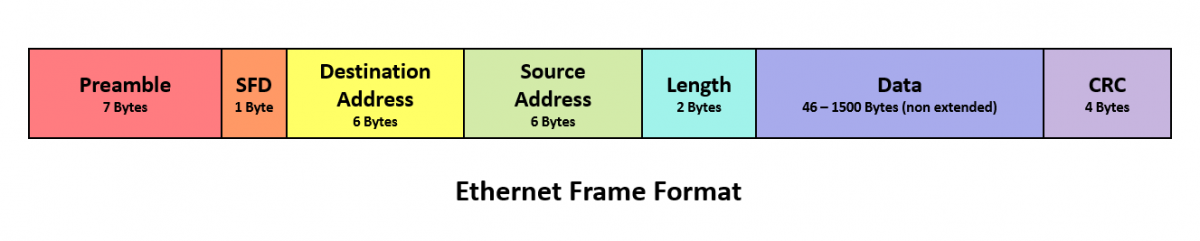
Finally, I was faced with my first ever ethernet frame, dissecting it to learn about each of the sections that make one up. These include the preamble, source and destination MAC addresses, VLAN header, ether type and the actual payload. I also learnt about the importance of the Frame Check Sequence section at the end and how it uses CRC to generate a checksum number, ensuring the integrity of data that is sent.
Overall, I've enjoyed this module as it's really started to get me thinking about how a network is actually set up and operates which isn't something I've ever considered before. It was also good to begin to understand how data is physically transmitted across a network with the use of ethernet. I can't wait to get on to the next module which is all about the third layer; the network layer!
Dave
No comments:
Post a Comment